
The 13th International Congress of Coptic Studies came to a close today after a memorable week in Göttingen, bringing together nearly 300 scholars from around the world. Hosted jointly by the Georg-August-Universität and the Academy of Sciences and Humanities, the congress reaffirmed Göttingen’s long-standing place among the great centres of global Coptology.
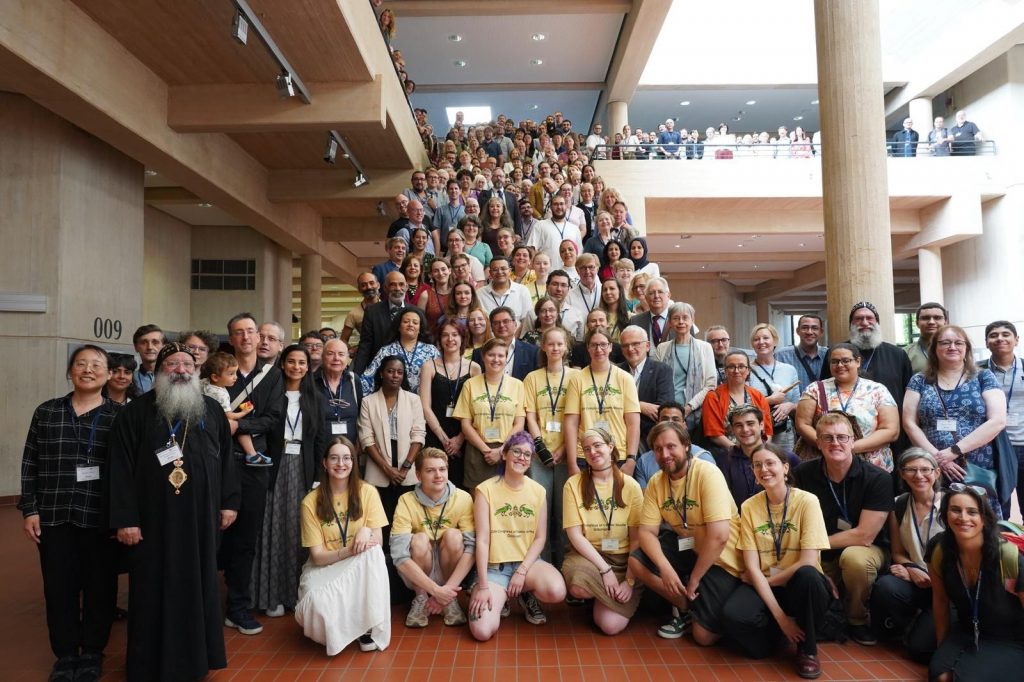
During the closing ceremony, outgoing IACS President Paola Buzi expressed her heartfelt gratitude to the many individuals and institutions whose commitment made the congress possible. She paid special tribute to Andreas Effland, who had been deeply involved in the organization of the meeting before his unexpected passing on 26 January 2026. His contribution was remembered with appreciation and affection. Thanks were also extended to the Georg-August University and the Göttingen Academy, to the university leadership and the Academy’s presidency, to Metropolitan Damian, representing the Coptic Church in Germany, to the Egyptian Embassy in Berlin, represented by the Cultural Counselor Prof. Soror, and especially to the many student assistants whose dedication ensured the smooth running of the congress. Particular recognition was given to Frank Feder, who served as Congress Secretary on behalf of the Göttingen Academy, and to Heike Behlmer, who coordinated the congress from the University. Together with an outstanding team of colleagues and student assistants, they organized an event that will long be remembered as a tremendous success.
The General Assembly of the International Association for Coptic Studies followed. Secretary Stephen Emmel commemorated colleagues who had passed away since the previous congress, including Theofried Baumeister, Martin Krause, Bentley Layton, Peter Nagel, Birger A. Pearson, Paul-Hubert Poirier, Michel Roberge, and Frederik Wisse. A moment of silence was observed in their memory. The Assembly also approved a revision of the IACS statutes introducing term limits for several key offices, including the Secretary, Webmaster, Editor-in-Chief of the Journal of Coptic Studies, and Director of the Cairo Center.
The meeting also marked an important transition for the Journal of Coptic Studies. Warm appreciation was expressed to Anne Boud’hors, who has served as editor since 2013. Beginning with the next volume, the journal will adopt a new editorial structure headed by Matthias Müller as Editor-in-Chief, working together with Korshi Dosoo, Esther Garel, and Ivan Miroshnikov as editors.
Another announcement concerned the publication of the congress proceedings. The organizers are planning to publish them online in open access with the support of the Göttingen State and University Library. In this way, a selection of papers presented during the past week will be freely accessible to researchers worldwide.
The Assembly also accepted the proposal to hold the 14th International Congress of Coptic Studies in Oslo in 2030. The event will be organized by Hugo Lundhaug (University of Oslo) and Victor Ghica (MF Norwegian School of Theology, Religion and Society). Participants enthusiastically welcomed the opportunity to continue the tradition of the congress in another important centre of Coptic scholarship.
The newly elected IACS Board was then announced. Tonio Sebastian Richter becomes President, with Sofía Torallas Tovar serving as President-Elect. Victor Ghica succeeds Stephen Emmel as Secretary, while Hugo Lundhaug assumes the office of Congress Secretary. Alin Suciu continues as Webmaster, Mennat-Allah El Dorry becomes Director of the Cairo Center, and Matthias Müller takes over as Editor-in-Chief of the Journal of Coptic Studies. The Members-at-Large are Florence Calament, Maher Eissa, Mary K. Farag, and Frank Feder, who joins the Board following Hugo Lundhaug’s move to the position of Congress Secretary.
In his inaugural address, the new President, Tonio Sebastian Richter, thanked Paola Buzi for her years of dedicated service and officially declared the 13th International Congress of Coptic Studies closed. Former President Paola Buzi remarked that the congresses have become “family reunions” for the international Coptic scholarly community, encouraging everyone to remain curious, collaborative, and open-minded.
Participants return home with new ideas, new collaborations, and lasting memories of an exceptionally successful congress. The Coptologists now looks forward to meeting again in the beautiful city of Oslo in four years’ time.